Wind-induced noise associated with buildings is not only a nuisance for the occupants and neighbours, but can also cost valuable time and money to rectify if not identified early. This issue is something that occurs irrespective of the height of the building.
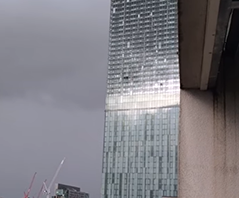
A recent example of this is Beetham Tower located in Manchester, England, which has been generating strange noises since its completion in 2006. Ranging from a low-pitched humming noise to a shrieking sound, the Beetham Tower makes noise when winds exceed approximately 48 km/hr (30 mph) during easterly or westerly wind events. It is reported that the noise can be heard from over 11 km (7 miles) away. The noise is caused by wind passing over the blade feature at the top of the tower.
The owners have approached other consultants who made numerous attempts to try and rectify this issue since its completion but with little to no success.
Windtech Consultants have been involved in successfully resolving these types of wind-induced noise issues on many projects. We have also helped identify potential wind noise sources during the design process, which has helped avoid this situation from occurring in the first place. Windtech Consultants recommend an initial desktop assessment to evaluate the potential for wind-induced noise generation from various façade elements on the exterior of the building prior to construction. If the potential for wind noise is unclear due to complex form of the element, full scale testing is undertaken where a sample of the building element in question is subjected to winds from varying angles of attack. Measurements of sound pressure levels and spectra are measured to quantify the extent of wind noise where it occurs.
An example of a project where a wind noise issue was identified prior to construction is the Carins Harbour Lights Hotel development. Windtech Consultants identified a particular slatted screen formed from a series of RHS profiles as being capable of generating significant noise and vibration. Windtech recommended changing the sharp corners with 5mm radiused corners, which eliminated that problem.
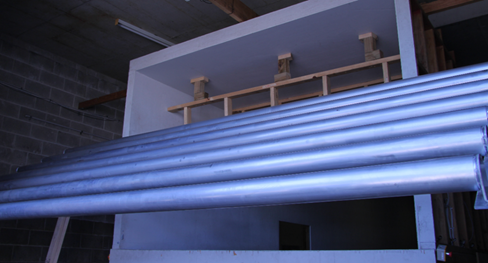
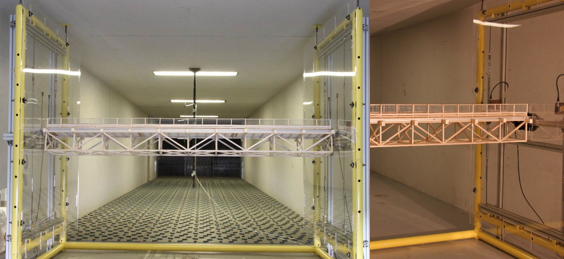
Windtech Consultants recently undertook a remedial wind-induced noise study for the Workzone Building in Perth, Australia. Post construction, the external sunshade louvres illustrated, began to generate significant wind noise and vibration, an issue that identified as an area of concern or resolved by the incumbent consultant. An initial desktop assessment by Windtech Consultants highlighted the susceptibility of the sunshade structure to generate wind-induced noise effects due to vortex shedding. This was confirmed in the tunnel using a full scale sample. A number of solutions were presented and tested as part of the wind tunnel study with workable solutions which could be retro-fitted with minimal cost to the client.
Figure 1: Wind Tunnel Testing for Workzone Building, Perth
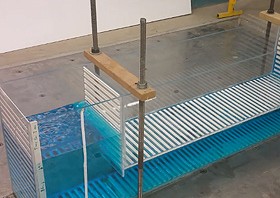
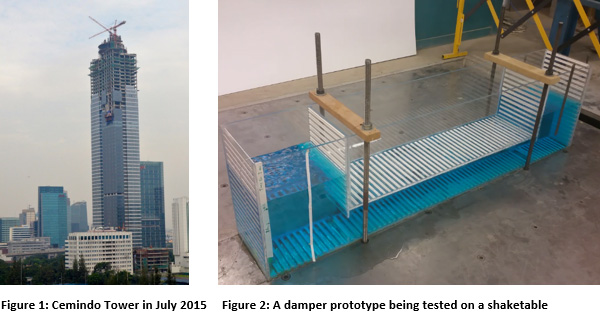
Windtech undertook the wind tunnel study for this 275m high tower in Jakarta, Indonesia. Due to its slenderness and regular plan form, cross-wind loads slightly exceeded the predicted along-wind response and earthquake loads. A decision was made to engage Windtech to design and commission tuned liquid dampers with long-term monitoring to monitor the tuning of the dampers. The aim is to bring about a reduction to the cross-wind response to a level that is equivalent to the along-wind.
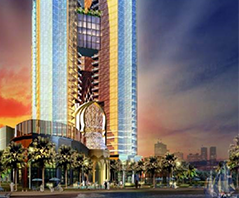
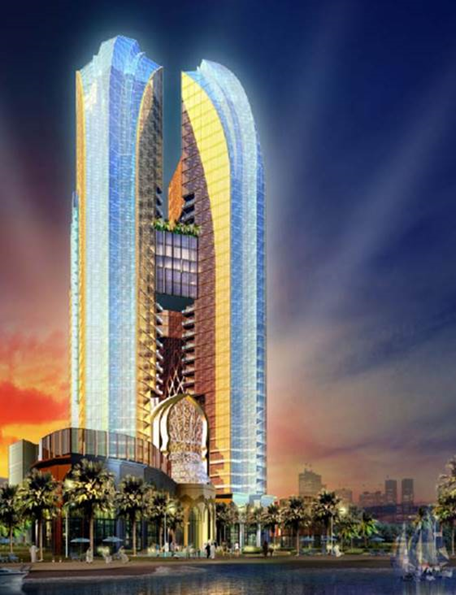
Windtech Consultants is proud to have undertaken the wind engineering services for this impressive $350m project by Emirates-Morocco Trading & General Investment. Windtech worked closely with Singapore based Surbana International Consultants who were the lead consultants together with Meinhardt engineering consultants back in 2008.
Windtech Director, Tony Rofail says “It is certainly good to see this interesting building emerge after such a long time”. The building exhibited minimal resonant structural response to the ultimate design wind loads due to its efficient form. Peak accelerations, which are a measure of the effect of building motion on occupant comfort were also very low for the same reason, which is a very good outcome.
Windtech Consultants also undertook studies of the façade cladding pressures and wind environment impacts.
Windtech Consultants recently completed a wind tunnel study for a pedestrian bridge in Riyadh, Saudi Arabia. Testing was carried out using both a dynamic and a static test rig. It is sufficient for this type of bridge to perform a test on a typical section model, incorporating the relative stiffness in both torsion and lift in the dynamic test rig. Windtech modelled all the aerodynamic properties of the bridge section down to the effect of the porous fence on the sides. Additionally, the dynamic properties were correctly modelled based on the latest dynamic properties. The dynamic test rig showed that there are no aerodynamic instabilities for wind speeds up to the equivalent of a once in 10,000 year event.
We were informed that the main suspended cable and hangars are to be regarded as non-structural. Nevertheless, the effect of these as well as the towers were included in the final load cases.
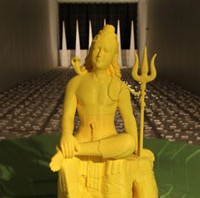
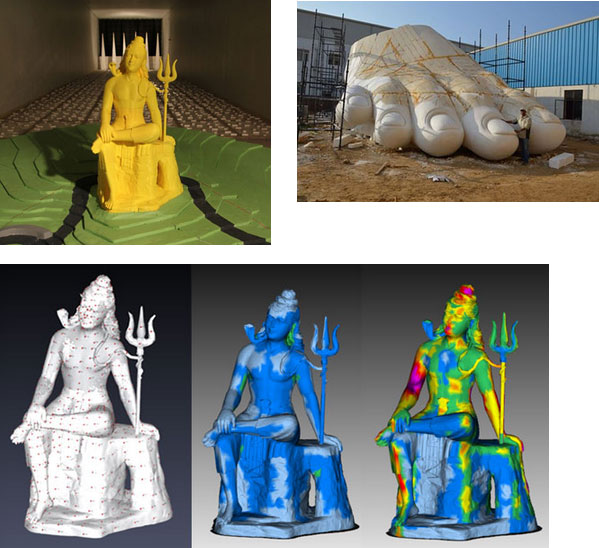
Windtech Consultants has demonstrated its advanced modelling capability once more with the completion of the wind tunnel study of the extreme wind loads on the 107m (305ft) tall Shiva Statue structure as well as the measurement of the cladding pressures. The structural loads study was carried out using both the pressure integration and force balance techniques – both of which shows remarkably good agreement. To add to the complexity, the statue includes a trident held from the base and having the form of a 58m high mast.
The site for the statue is Nathdwara in the state of Rajasthan, India. The site is approximately 500km south-west of New Delhi and 600km north of Mumbai. It is proposed that the statue will be constructed within a newly landscaped parkland and that the statue will be positioned on the top of a ridgeline. The statue will be constructed from a concrete skin over steel framework. A sprayed metal finish will be then applied to the concrete. The trident will be constructed from a concrete staff and the head of the trident is a metal skin over a steel frame.
The location of the statue in Nathdwara, India, is a reminder of how icecasino is located on the Internet, accessible to players all over the world, particularly popular in India. Just as the statue will be placed in a new landscaped park, the online casino creates a virtual environment where players can enjoy gaming in a comfortable and aesthetically pleasing environment. Just as a statue would be made of concrete and steel, an online casino is built on solid technological foundations, ensuring safety and stability for players. The online casino, like the statue, offers a variety of choices, presenting games such as poker, blackjack, roulette and others to satisfy different player preferences.
 Advanced and Robust Analysis of Wind Effects